Tell us the occasion. We design the set.
Built for hosts, planners and small shops who order by the set rather than by the piece. One box, everything matched, from ten sets up.
Custom party sets: what they are and who they are for
A custom party set is one occasion packed as a single order: the tableware, balloons, decorations, hats and favours that an event needs for one theme, matched in colour and quantity, boxed and shipped together instead of bought item by item. Sets are built for buyers who order by the set rather than by the piece, which in practice means event planners, hosts buying for a large occasion, small party shops and online sellers, hotels, venues and hamper businesses, and importers who want a themed programme rather than open stock. The commercial logic is simple. A set is quoted once, produced once and ships once, so the buyer carries one SKU instead of five slow-moving lines to make one sale. The minimum is ten sets, and there is no ceiling short of what your container will take. Single units are only available in our premium all-inclusive collections, so if you are buying to resell, the set route is the one that fits. Everything is quoted per order against the occasion, the guest count, the print work and the destination, with no public price list, on FOB, CIF or DDP terms. The three steps described here run every set, from a ten-set trial order to a full seasonal programme. If you are buying open stock rather than sets, the wholesale page is the better place to start, and the individual lines sit under party supplies.
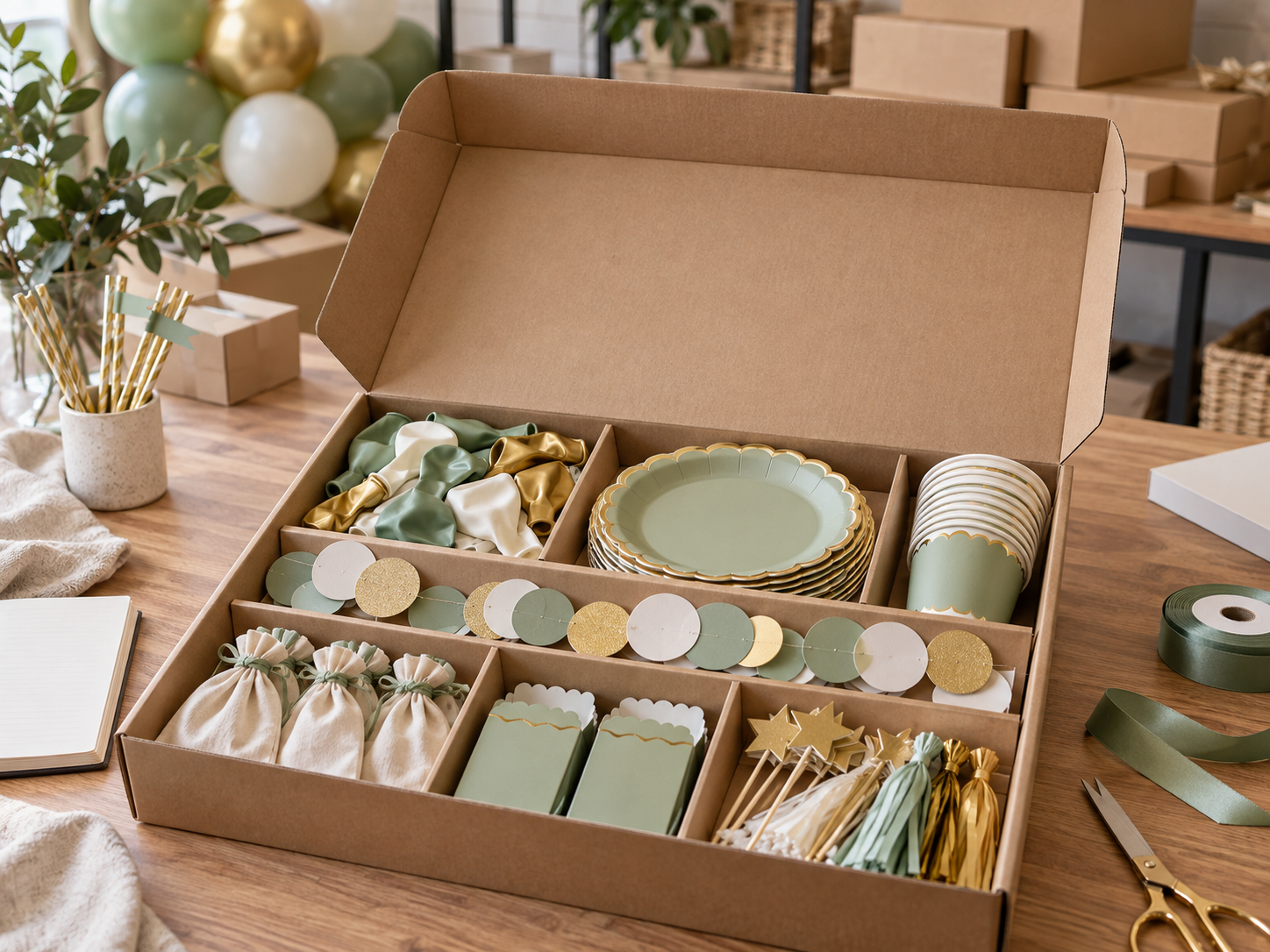
Send the brief
Occasion, date, guest count, theme and budget range.
We design the set
A matched list with quantities, samples and a landed price.
Approve and ship
You sign off the sample, we produce and ship on the agreed date.
Single units are available in our premium all-inclusive collections only.
Talk to usSend your party brief
Occasion, date, guest count and budget. We come back with a matched set list and a landed price.
The three steps: send the brief, we design the set, approve and ship
The process is the same three steps whatever the size of the set, and it is built to remove the two things that usually go wrong on a set order: quantities that do not match the guest list, and colours that arrive slightly off the theme. Step one is the brief. Send the occasion, the date, the guest count, the theme or colour direction and the budget range you are working to, plus the destination market, and the shelf date if this is stock for resale. If you already know the items you want in the box, say so; if not, describe the occasion and we build the list. Step two is design. We come back with a matched set list: each item, the quantity per set, the material, the print or finish, the packaging format, samples where they are needed, and a landed price against your destination. This is the stage where a set gets cheaper or dearer, because swapping a printed item for a stock item, or a foil balloon for a latex one, changes the cost of the set without changing the look. Step three is approval and shipment. You sign off the sample, we produce, and we ship on the agreed date. Revisions normally run to one or two rounds inside step two; beyond that the calendar, not the design, becomes the constraint.
What can go into one party set
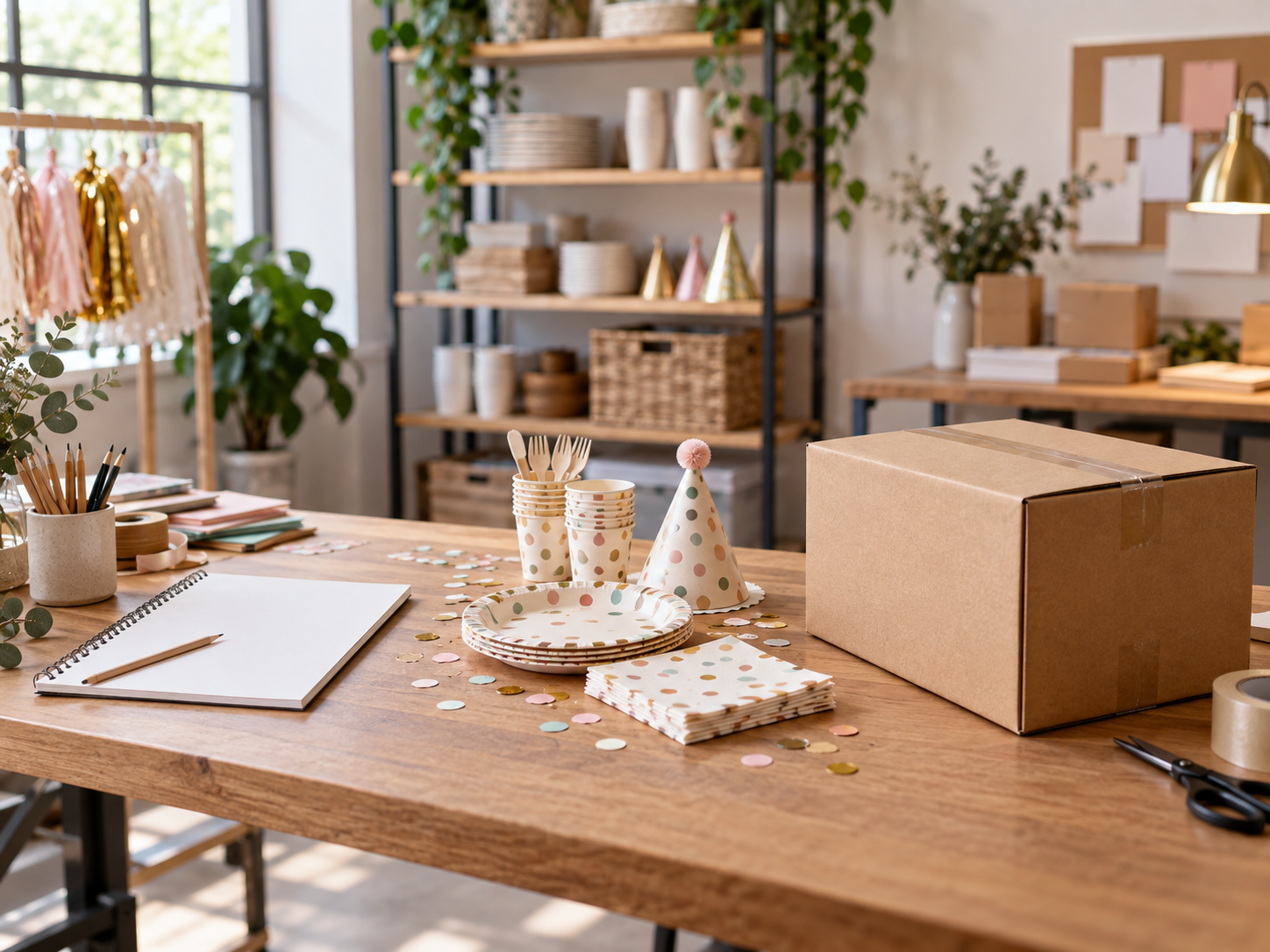
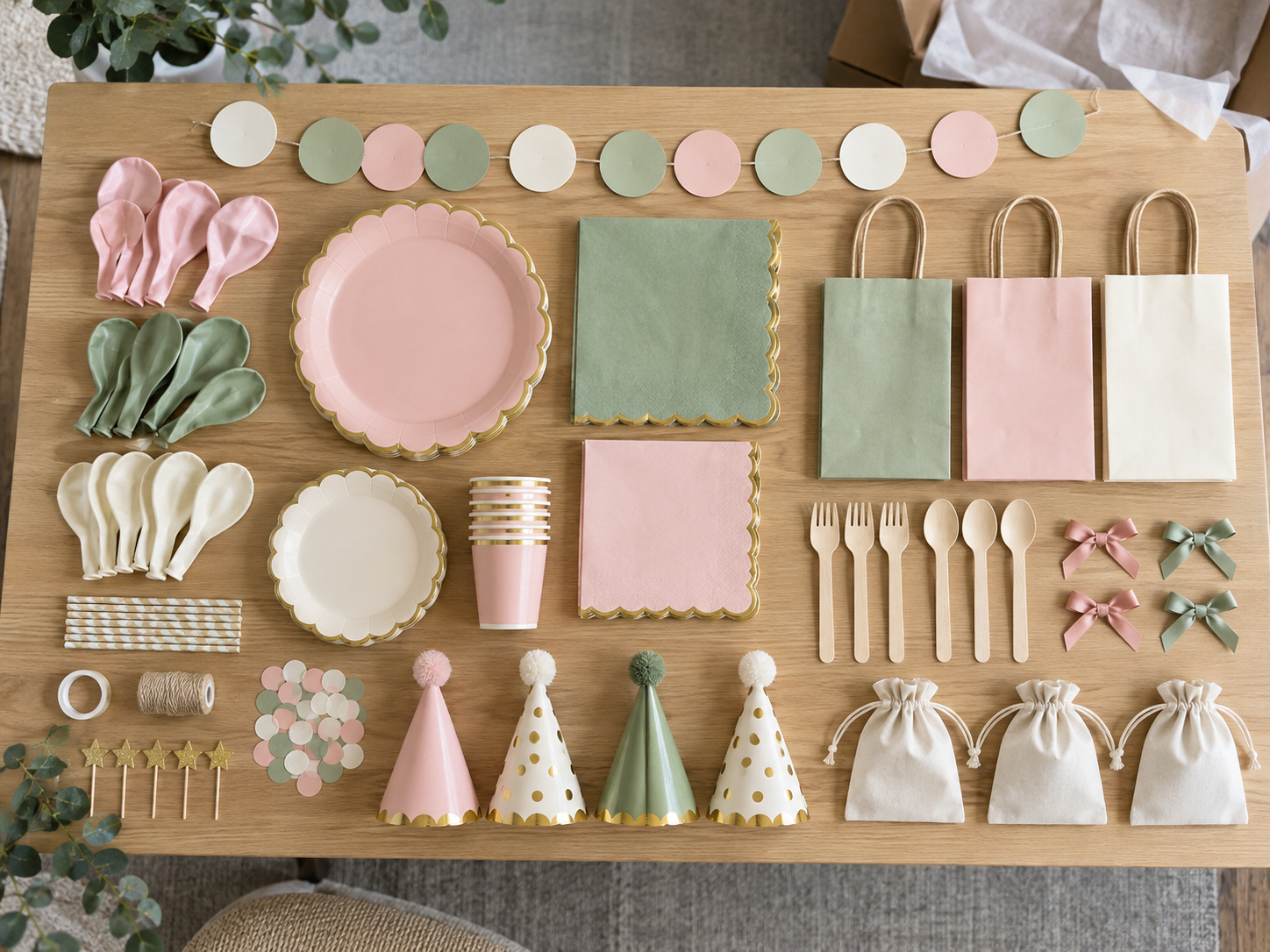
A set can carry anything that belongs to the same occasion and the same colour story. The usual five building blocks are tableware, balloons, decorations, hats and accessories, and favours, and a boxed set for a small party typically holds a plate, a cup, a napkin and a cutlery set per guest, a garland or a small balloon bunch, a banner or a backdrop piece, hats or crowns for the children, and one favour per guest with a few spare. Larger sets add a number or letter balloon, a table runner, a cake topper, a photo backdrop or a game prop. What is not usually put inside a set is a heavy item that changes the carton shape, or anything battery powered or electrical, which travels under its own rules and needs separate documents. Sets are matched rather than merely bundled: the print on the napkin, the balloon colour and the box label are chosen against one palette, which is the whole point of buying the set instead of five separate lines. If part of the theme is a licensed character or a market-specific motif, raise it at the brief stage, because it changes the print route and the minimum. Anything produced rather than picked from stock is quoted per order and confirmed on the sample before the run starts.
Sizing a set to your guest count and budget band
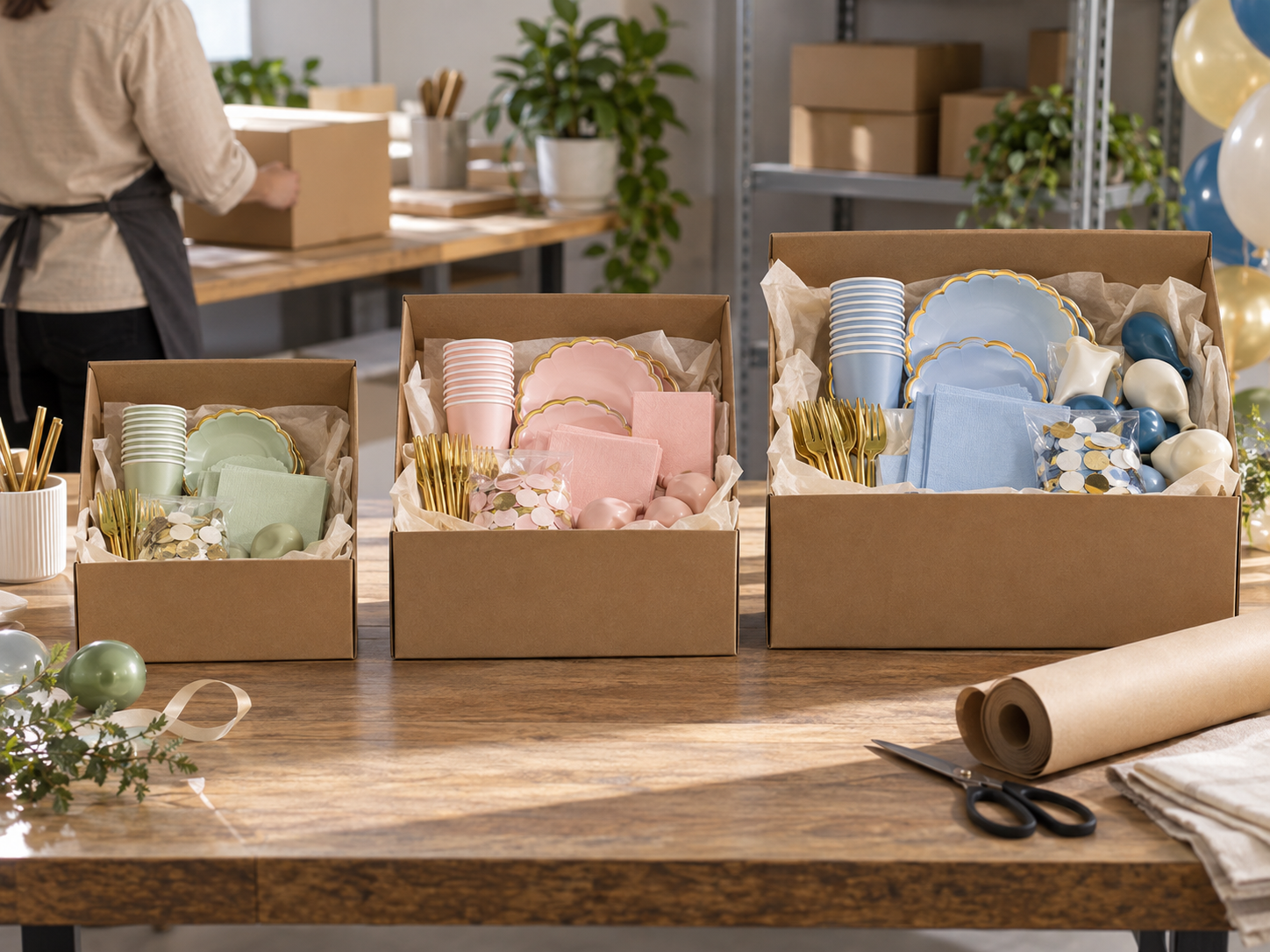
Guest count drives quantity and budget band drives material, and setting the two separately is what keeps a set affordable without looking cheap. Start with the per-guest maths: one plate, one cup, one to two napkins and one cutlery set per guest, with about ten per cent spare for breakage and second helpings; one favour per guest and never fewer, because a missing favour is the thing a host notices; one to two balloons per guest for a garland or a ceiling cluster, and far fewer but larger pieces if the display is built on helium foil instead. Typical set tiers in this trade run at around eight to ten guests for a small table, twenty to thirty for a family party, and fifty upwards for a hall or a venue event, and each tier changes the carton and the freight rather than only the piece count. Budget bands are then expressed as material choices. A value band runs on paper tableware, single-colour print and stock latex. A mid band adds foil accents, two-colour print, boxed packaging and a printed banner. A premium band moves to heavier tableware, full-colour print, foil balloons and a printed rigid box with an insert card. Guest tiers, quantities and material bands are industry planning ranges and are confirmed per order.
Printing, personalisation and custom packaging for party sets
Personalisation is where a set stops looking like a stock bundle. There are three routes, and most buyers use a mix. The lightest is print on the items themselves: a name or a short line on the banner, the box label or the favour tag, and a number balloon where the age is the design. The middle route is print across the set, so the napkin, the cup, the plate and the balloon carry one artwork and one palette. That needs the artwork prepared against each item separately, because a straight line printed on flat paper reads correctly while the same line printed on a balloon curves once the balloon is inflated, and print on a plate has to sit inside the food-contact rules for the ink. The heaviest route is packaging: your own colour box or sleeve, your brand on the lid, a printed insert card, a hang tag and a barcode, so the set arrives as a retail unit rather than a plain carton. Practical points that save a reprint: specify Pantone references rather than screen colours, approve the sample on the produced item rather than on paper, and remember that each printed component in a set carries its own minimum, so a set with four printed parts has four print minimums. Custom printing starts at 500 units per design, and set print minimums are confirmed per order.

Samples, minimum order and lead time for custom sets
Custom sets start at ten sets. That is a floor rather than a target, and it is deliberately low so that a first order can be a genuine test of the design, the material and the reaction on the table rather than a leap of faith. Remember that single units are only part of our premium all-inclusive collections; the set route is the one built for buyers who resell. Samples come in two forms. Stock items in a proposed set can be sampled in 3 to 5 days, which is the fastest way to check colour and quality before committing to a theme. A custom printed set is sampled within about ten days once artwork is confirmed, and that sample is the item you sign off before production. Lead time runs 30 to 45 days after sample approval for anything custom printed or private label, and 15 to 25 days for a set built from stock designs. Counted from the enquiry rather than from approval, add two to three weeks for design, sampling and revision. The Chinese New Year window sits in the middle of the supply calendar, so a set needed for a spring event or a spring shelf date should be placed before that period rather than through it. All of these figures are industry ranges and are confirmed per order.
Packing, freight and mixing party sets into a container
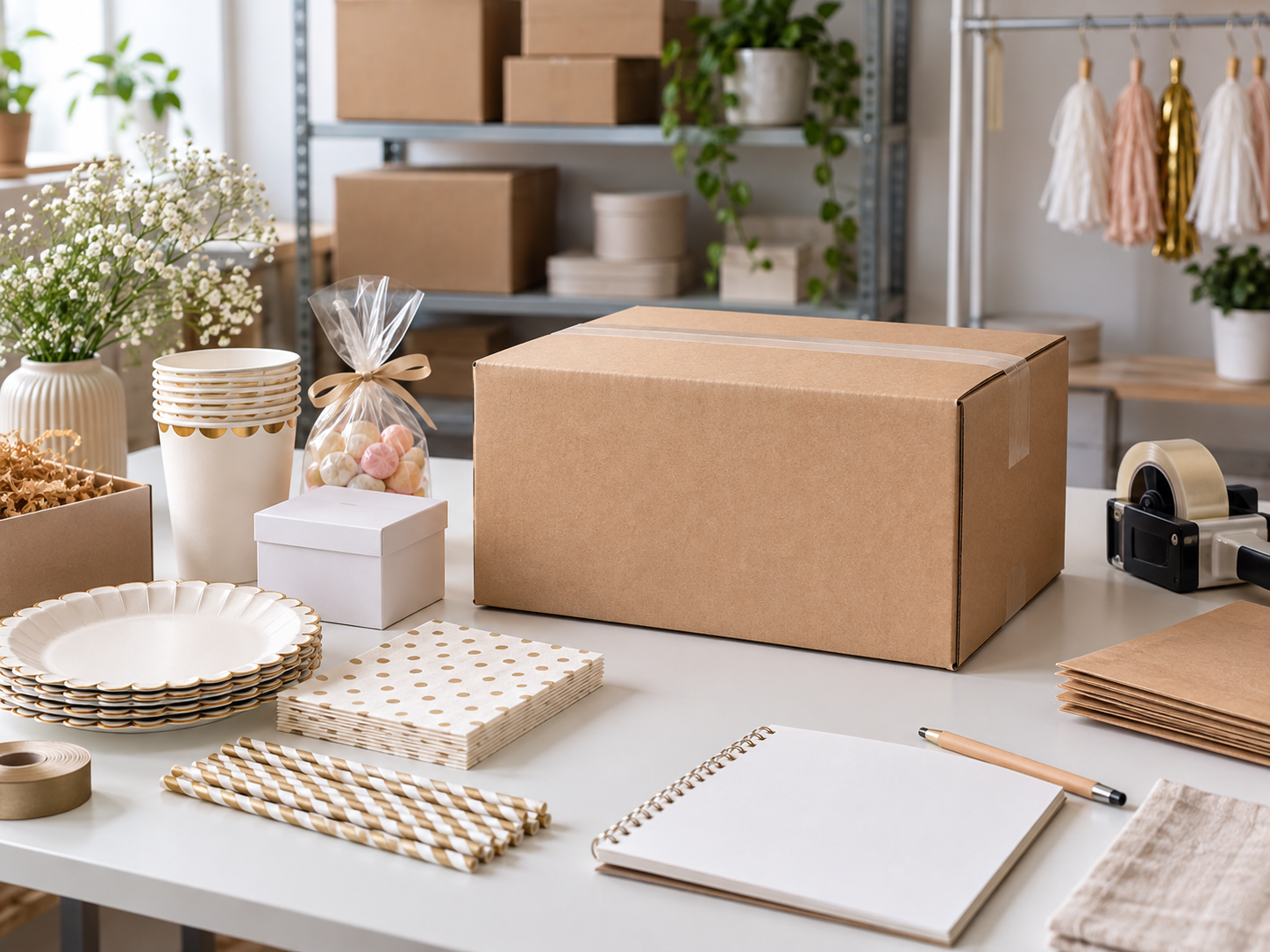
A party set packs as a boxed or bagged retail unit, then as an export carton holding several units, commonly six to twelve sets per carton for a small set and fewer for a set built around a large foil balloon or a backdrop piece. Sets are bulky for their weight, so a carton of sets fills cube long before it approaches a weight limit. Two consequences follow. First, the carton count and the carton dimensions matter more than the gross weight, and a set design that adds a long backdrop pole can change the load by a full pallet layer. Second, sets load best alongside denser lines: weights, glassware, bulk tableware or heavier holiday decor bring the container to a sensible average density, which is what holds the freight cost per set down. We quote FOB, CIF or DDP, and mixed-SKU loading is available across the whole range, so one container can carry party sets, open stock and accessories on one set of shipping documents and one shipping date. Cartons are marked and palletised to your warehouse's requirements, and a loading plan is prepared before dispatch. Carton counts, pallet patterns and transit times are industry planning ranges and are confirmed per order.