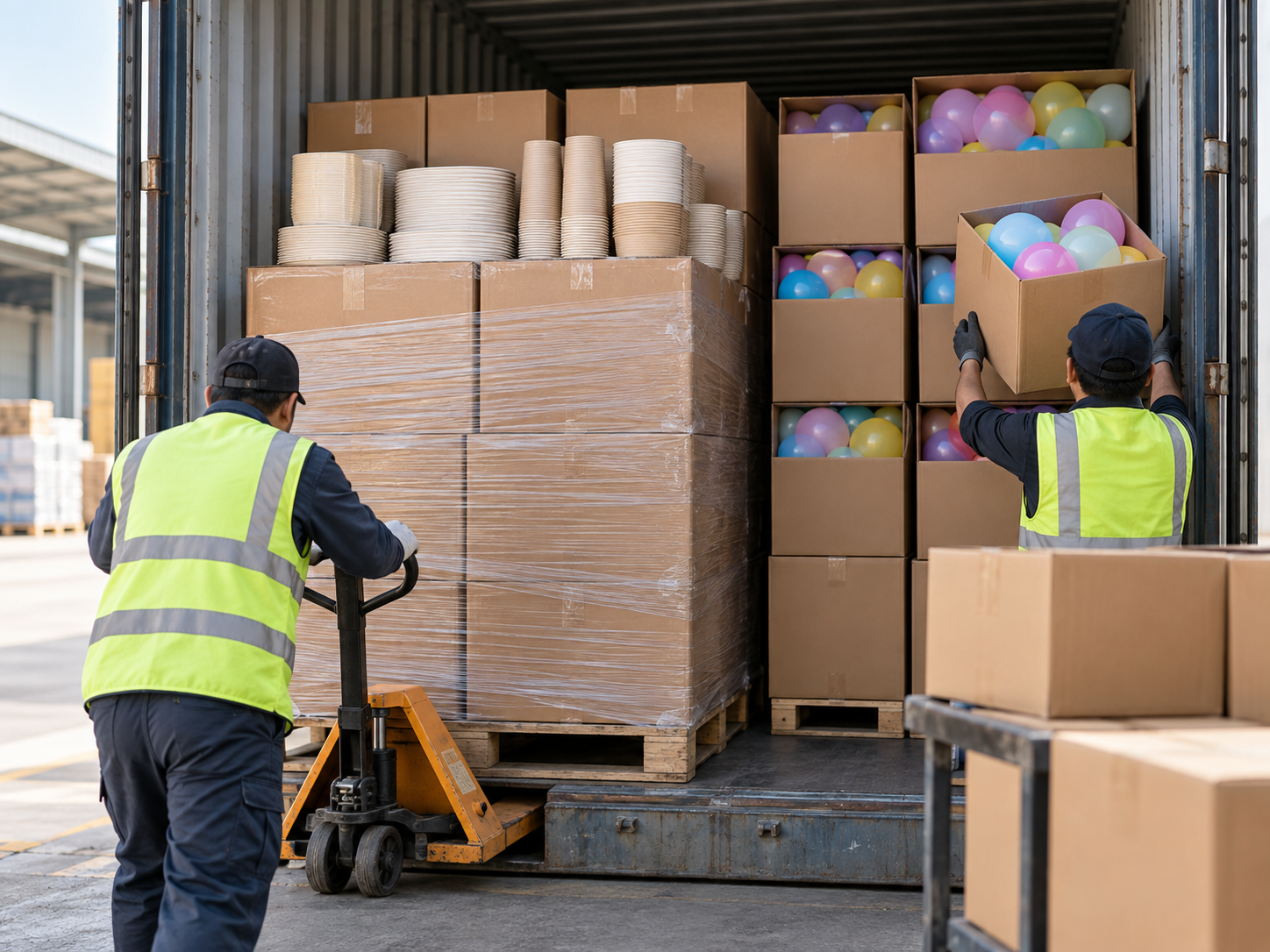
Buy it by the container
We supply importers, retail chains and event companies. Pricing is quoted per order, so there is no public price list.
Wholesale and OEM supply: how an order works with WW Revel
WW Revel supplies wholesale holiday and party goods to importers, wholesalers, retail and variety chains, event and wedding suppliers, hospitality buyers and online sellers. The commercial shape of an order is short. Wholesale orders start at one mixed pallet, most designs carry a 500-unit minimum per SKU, custom printing starts at 500 units per design, and custom party sets start at ten sets. Pricing is quoted per order against the range, the quantity, the print work and the destination, so there is no public price list. Goods are supplied under FOB, CIF or DDP terms, and one container can carry the full range with no forced volume per design. Branding is available at every level: your artwork produced to your specification, an existing design carrying your brand, or your own packaging and barcode on a stock item. Testing is handled per item and per market rather than as a general statement, and the report for a specific item is provided per shipment on request. The rest of this page follows the order buyers usually ask about: branding, categories, compliance, trade terms, payment and container loading. Send the range you are interested in, the quantity and the destination, and you will have a quotation back rather than a catalogue to work through.
OEM & private label
Your artwork, your packaging, your brand on the box.
Mixed-SKU loading
One container carrying the full range, with no forced volume per design.
Tested and certified
EN 71 and destination-market testing documented per shipment.
Delivery terms
FOB, CIF or DDP, quoted against your destination port.
Request a wholesale quote
Tell us the range, quantity and destination. We quote per order — there is no public price list.
OEM, ODM and private label: putting your brand on the range
Three arrangements sit under the OEM heading, and most buyers start with one and end up using a mix. Full OEM means you specify the product: the size, the material, the gram weight, the colour, the print artwork and the packaging, and we produce to that specification. This is the route for a retailer building its own line, and it asks the most up front: artwork in a usable format, a barcode per SKU, pack copy and the mandatory warnings for each market you sell in. Private label means the product itself is a stock item and your brand goes on the retail unit: your poly bag or colour box, your printed header card, your logo on the item and your barcode on the back. It is the fastest route to a branded shelf presence because sampling and tooling stay minimal. The middle option, often called ODM, is a design that already exists in the range and takes your logo, your colourway or your packaging. Practical requirements are the same on all three routes: artwork with Pantone references rather than screen colours, barcodes supplied to the format the destination market requires, multi-language pack copy where you sell into more than one country, and a sample approved on the produced item before the production run starts. Print minimums start at 500 units per design, and branded minimums are confirmed per order.

Categories we supply on a wholesale programme
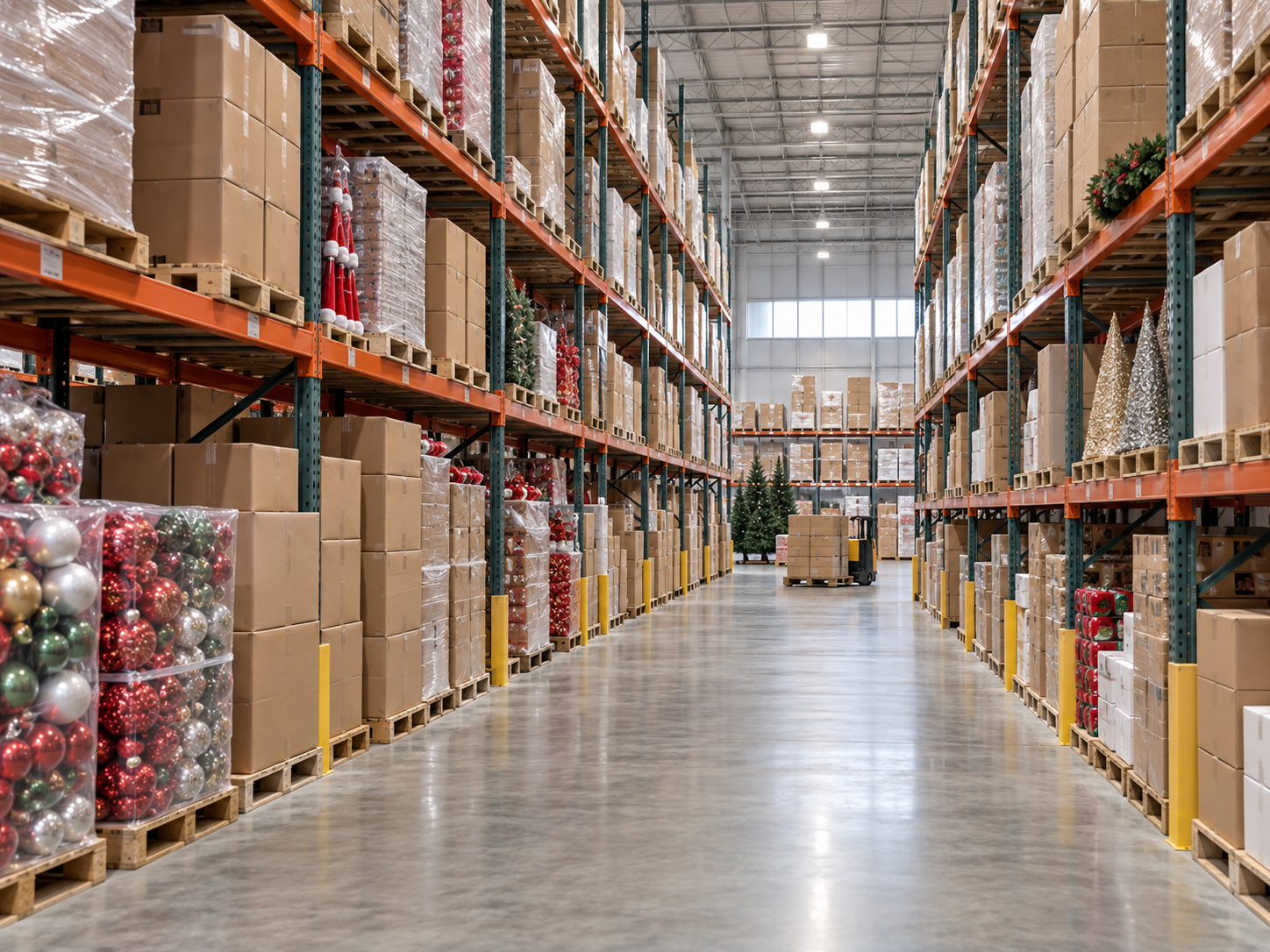
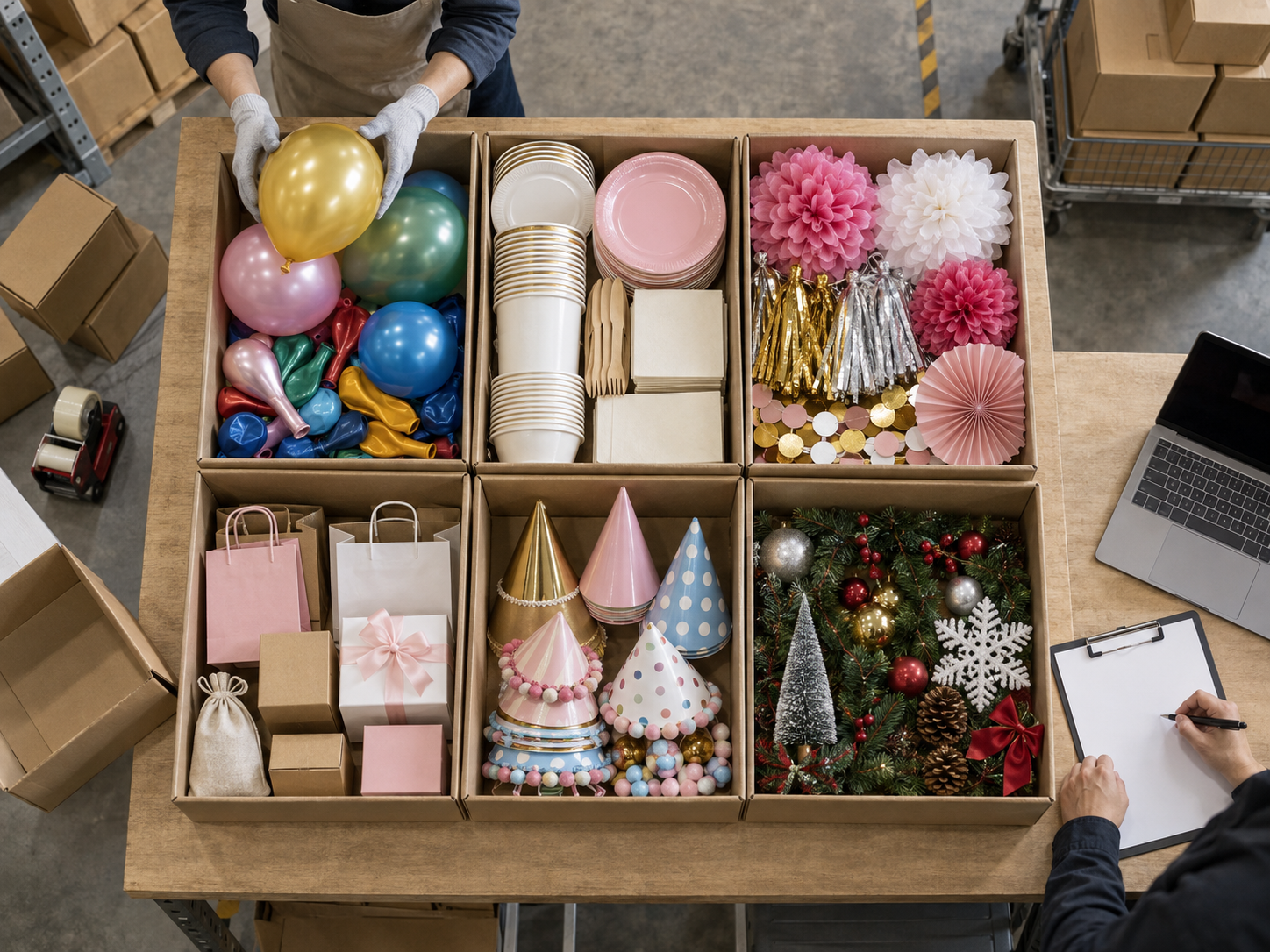
The wholesale programme covers the same lines as the rest of the site, and they can be combined on a single purchase order. Holiday goods run across five programmes, Christmas, Halloween, Easter, Ramadan and New Year, covering trees, garlands and baubles, props and yard decor, eggs and baskets, lanterns and crescent decor, backdrops, hats, tableware and countdown kits. The full list for each one sits on the holiday pages. Party supplies run across five lines, balloons, tableware, decorations, hats and accessories, and favours, described under party supplies. Occasion programmes for birthday, baby shower, wedding, graduation, Valentine's Day and St Patrick's Day sit under occasion programmes and pull from both sides of the range, and custom party sets built to a brief are described under custom party sets. Two consequences follow for a buyer. An order can be built SKU by SKU rather than committed line by line, because mixed loading removes the volume requirement per design. And a first order can stay small enough to test a market while still arriving on one set of shipping documents against one shipping date. Which items are produced in house and which are sourced within the supply base is stated item by item on the quotation, so you know what is behind each line before you commit.
Testing and market compliance for your destination market
Every market has its own document family and they are not interchangeable, so the only honest answer to a compliance question is an item-specific one. Items can be produced to the standards your market requires. Ask us for the current test reports for the specific item and the specific market, and read those rather than relying on a category description. In this range that usually means several report families rather than one. Items intended for children, including balloons and party novelties, sit under EN 71-1 for mechanical safety, EN 71-2 for flammability and EN 71-3 for migration of elements in Europe, with CPSIA and ASTM F963 as the United States equivalents. Printed plastics and films attract phthalate limits such as DEHP, DBP and BBP, and an item can fail on its ink rather than on its base material. Tableware is a food-contact product with its own report family. Battery and LED items are electrical goods with their own standards and, where button cells are used, transport paperwork. Helium is a Class 2.2 compressed gas with separate transport rules. Send the destination market, the items and the age group at enquiry stage and we will tell you which documents are issued against that shipment. Nothing on this page is a statement that a given item is already approved for a given market.

FOB, CIF and DDP: which trade term fits your order
FOB, CIF and DDP differ in how far the quoted price follows the goods, and the right choice depends on whether you have your own forwarder. On FOB, the price covers the goods delivered to the port of loading and cleared for export; you book the freight and own the risk from that point. It is the term most importers choose once they have a forwarder and a consolidated route, because it keeps their freight costs visible and lets them combine suppliers in one booking. On CIF, the price also covers the sea freight and insurance to a named destination port, so a single number covers the goods and the sea move; it suits a buyer who would rather not manage the booking, though it stops at the port. On DDP, the price covers delivery to your address with duty and inland movement included. It is the term that needs the clearest brief, because duty depends on the product and the destination. Under every term, mixed-SKU loading is where the freight saving sits: one container can carry the full range with no forced volume per design, so bulky goods and dense goods travel together and the container loads to a sensible average density. Sea transit from Asia to Europe or North America typically runs 30 to 40 days, plus about two weeks for port and inland movement. Trade terms and transit windows are confirmed per order.

The order process and how payment usually works
An order runs through a standard sequence, and each step produces the document the next step depends on. It starts with an enquiry: the range or item list, quantities, destination, target date and any branding requirement. We return a quotation against that brief, priced per order rather than from a list. If the goods are custom or branded, a sample is produced and approved on the produced item before production starts. When you confirm, we issue a proforma invoice, and that is where the commercial terms sit: the goods, the quantity, the price, the trade term, the shipping window and the payment arrangement. Payment in this trade is normally staged, with part of the value paid against the order and the balance settled around shipment, and the exact split is agreed case by case on the proforma invoice rather than published anywhere. The instruments usually involved are bank transfer and, for larger programmes, a letter of credit arranged between the banks. Production then follows the approved sample, packing and carton marks are prepared against your warehouse requirements, and the shipping documents, which normally means the commercial invoice, the packing list, the bill of lading and the certificate of origin where it is required, are issued against the shipment. One named contact stays on the order from first quote to final delivery. Payment structures and documents are confirmed per order.

Mixed containers: loading bulky and heavy goods together
Mixed loading is the single biggest lever on landed cost in this product family, because the range is deliberately mixed density. Balloons, decorations, party hats and boxed sets are light and bulky: they fill a container long before they reach its weight limit. Bulk tableware, weights, glassware, metalised accessories and heavier holiday decor do the opposite. Loaded on their own, each side of the range wastes part of the container, one cubing out and the other weighing out. Loaded together, the container reaches a sensible average density and the freight cost per unit falls. What that means in practice: no forced volume per design, so a container can carry many SKUs in the proportions your shelves need rather than pallet quantities of a few; cartons specified in sizes that stack and palletise cleanly together; and a loading plan prepared before dispatch so that the unloading sequence at your warehouse matches the way the container was stowed. Pallets, loose cartons and a pallet-plus-loose mix are all workable, and the container type is chosen against the cube and the weight of the specific mix rather than by habit. Helium cylinders stay out of general mixed cargo because they travel as a compressed gas under their own rules. Carton counts, pallet patterns and container utilisation are planning ranges and are confirmed per order.